Segregation of Duties (SoD): The ERP Control Gap Most Organizations Still Struggle to Close
Segregation of Duties (SoD) has long been a critical control in Enterprise Resource Planning (ERP) and financial systems. Yet many organizations still struggle to keep SoD risks under control as users, roles, and business requirements continue to evolve.
The challenge isn’t understanding the importance of SoD. It’s managing it effectively. Strong ERP Access Controls depend on continuous visibility into who has access to what, and where conflicts exist.
As a result, many organizations continue to face repeat audit findings, delayed remediation efforts, and growing compliance pressure.
So, the real question is no longer whether SoD matters.
How can organizations continuously manage SoD risks without creating more work for audit, compliance, and IT teams?
Why SoD Has Become Increasingly Difficult to Manage
Most organizations initially establish segregation rules during ERP implementation. Over time, however, those controls begin to weaken. Several factors contribute to this challenge:
Growing User Populations: As organizations expand, more users require system access. New hires, contractors, role changes, and business acquisitions create a constantly evolving access landscape.
Role Complexity: ERP roles are rarely static. Employees often receive additional responsibilities to support changing business requirements. What starts as a simple role structure can quickly become a web of overlapping permissions that introduces unintended SoD conflicts.
Manual Review Processes: In many organizations, SoD reviews still depend on spreadsheets and manual assessments. Teams spend significant time:
- Pulling access reports
- Comparing roles
- Identifying conflicts
- Validating mitigating controls
- Documenting evidence
- Preparing audit support materials
A typical SoD review can require teams to manually analyze large volumes of permissions, role assignments, and exceptions across ERP environments.
This process is resource-intensive and often performed quarterly or annually rather than continuously.
As a result, risks can remain hidden between review cycles.
The Real Cost of Waiting for the Audit
One of the biggest misconceptions about SoD is that it is primarily an audit requirement.
In reality, poor SoD management creates operational and compliance risks long before an audit begins.
- A user with conflicting access may have the ability to:
- Create and approve vendors
- Initiate and approve payments
- Create and post journal entries
- Request and approve purchases
- Execute conflicting finance transactions
Industry guidance regularly highlights SoD conflicts as a major risk because ERP users can accumulate permissions that allow them to perform incompatible activities without independent oversight.
- The problem is that organizations often discover these issues only during:
- Internal audits
- External audits
- Compliance reviews
- Regulatory examinations
- By that point, the organization must:
- Investigate historical activity
- Validate mitigating controls
- Gather documentation
- Explain exceptions
- Implement remediation plans
And unfortunately, many of the same findings reappear during the next audit cycle.

Why Traditional SoD Reviews Are No Longer Enough
The fundamental flaw in many SoD programs is timing. A quarterly evaluation may identify conflicts that have existed for several months. An annual review can leave organizations exposed for even longer.
Meanwhile, business activity continues uninterrupted.
The reality is simple:
Access risks evolve continuously. Therefore, SoD monitoring should be continuous as well.
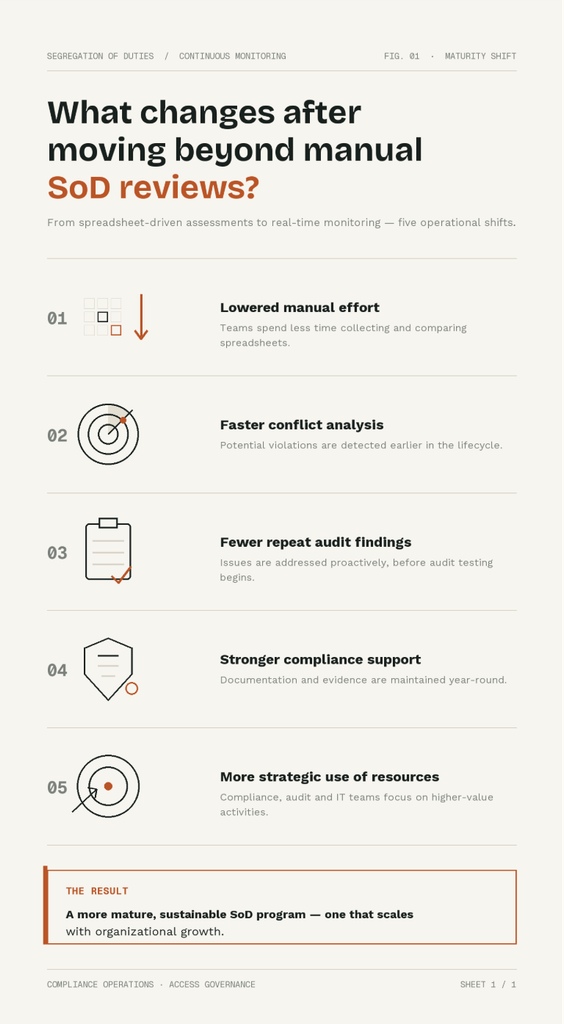
Rather than reviewing thousands of users once or twice a year, organizations need a way to identify high-risk conflicts as they emerge and focus attention on the exceptions that actually matter.
This shifts SoD from a reactive audit exercise to a proactive risk management process.

A Better Approach: Continuous SoD Monitoring
Leading organizations are moving toward a more automated SoD model. Instead of investing countless hours manually analyzing access reports, they use predefined rules to evaluate user access and continuously identify possible issues.
This approach delivers several advantages:
- Earlier Detection
Potential issues can be identified and addressed earlier, before they result in audit findings. - Focus on Exceptions
Teams spend less time reviewing entire user populations and more time investigating genuine risks. - Improved Documentation
Supporting evidence and remediation activities can be maintained year-round rather than reconstructed during an audit. - Better Collaboration
Compliance, Internal Audit, IT Security, and business stakeholders gain a shared view of SoD risks and remediation progress.
The result is greater visibility with significantly less administrative effort.
Where Organizations Can Start Without a Large GRC Transformation
Many organizations assume improving SoD requires a major governance, risk, and compliance (GRC) initiative.
That assumption often delays progress.
The truth is that organizations don’t always need a large-scale transformation to start improving SoD controls. A targeted solution that focuses specifically on ERP access risks can deliver meaningful results much faster. This is where many finance, audit, and compliance teams look for practical solutions they can deploy quickly and that start delivering immediate value.

Introducing EagleEye365®: A Practical Approach to SoD Management
For organizations looking for a focused and efficient way to address ERP access risks, EagleEye365® provides a lightweight, targeted solution for organizations looking to address SOD and access risks.
Rather than requiring a lengthy GRC transformation, EagleEye365® helps organizations:
- Discover potential SoD conflicts automatically
- Monitor access continuously
- Focus on meaningful exceptions
- Improve audit readiness
- Support compliance activities with stronger evidence
- Gain visibility into user access risks
Most importantly, organizations can begin tackling immediate SoD concerns without undertaking a massive technology project.
This makes SoD improvements achievable for organizations that want quick results and improved visibility into SOD risk.

The Business Value of Modern SoD Management
When organizations improve SoD monitoring, the benefits extend beyond compliance.
They gain:
- Better control over ERP access risks
- Stronger financial governance
- Reduced fraud exposure
- Greater confidence during audits
- Improved collaboration between business and control functions
- Enhanced operational efficiency
Most importantly, they move from reacting to audit findings to identifying and addressing issues earlier.
Continuous SoD monitoring also strengthens ERP Compliance by helping organizations demonstrate consistent control enforcement, improve audit readiness, and support evolving regulatory requirements.
That’s where the real value lies.
Conclusion: Start Small, Solve a Real Problem, Demonstrate Value
Improving Segregation of Duties does not have to begin with a large transformation initiative.
Organizations can make meaningful progress by focusing on a specific challenge: identifying and managing SoD conflicts more effectively.
The key is to shift from periodic, manual reviews to a more continuous, automated approach.
By detecting conflicts earlier, focusing on exceptions, and strengthening audit readiness, organizations can reduce risk, improve efficiency, and eliminate many of the recurring issues that generate audit findings.
Solutions such as EagleEye365® provide a practical starting point, helping teams establish continuous SoD monitoring without the complexity of a major GRC overhaul.
Ultimately, the goal isn’t simply passing the next audit. It’s building a sustainable control environment where risks are identified early, compliance becomes easier, and the business can operate with greater confidence.
FAQ’s
Segregation of Duties (SoD) is a control framework that prevents a single user from performing conflicting tasks within an ERP system. It helps reduce fraud risk, strengthen internal controls, and support regulatory compliance.
SoD conflicts occur when users have access to incompatible functions, such as creating and approving transactions. Auditors often flag these conflicts because they increase the risk of errors, fraud, and control failures.
Traditional quarterly or annual reviews may leave risks undetected for long periods. Continuous SoD monitoring helps organizations identify conflicts as they emerge, improving compliance and audit readiness.
EagleEye365® helps identify potential SoD conflicts, supports continuous ERP access monitoring, and highlights high-risk exceptions so teams can address issues before they become audit findings.
Yes. EagleEye365® provides a focused approach to SoD monitoring and ERP access controls, allowing organizations to strengthen compliance, improve audit readiness, and reduce risk without a complex GRC transformation.
Continuous SoD monitoring helps organizations detect access conflicts early, validate controls faster, and maintain documentation throughout the year, reducing the likelihood of repeat audit findings and compliance issues.