
Many control automation initiatives stall because compliance teams understand the control objective, while IT teams need clarity around source systems, required data, business rules, exception criteria, and evidence requirements before development can begin. Successful automation starts by translating compliance requirements into clear technical requirements that both teams understand and can support through Continuous Control Monitoring.
Why Compliance Control Automation Projects Stall
If you’re responsible for managing or evaluating controls, you’ve likely sat through meetings where everyone agrees a control should be automated. However, months later the project still hasn’t moved forward.
The business team identifies a control that should be automated. Everyone agrees automation will reduce manual effort, improve consistency, strengthen compliance, and support Audit Readiness Automation initiatives.
Then the project slows down. Not because the technology doesn’t exist. Not because IT lacks resources. Not because anyone disagrees with the objective.
The project stalls because the control requirement has not yet been translated into the information IT needs to automate it.
This is one of the most common challenges organizations face when pursuing control automation.

The Hidden Gap Between Compliance and IT
Compliance teams typically understand what the control is supposed to accomplish.
IT teams need to understand:
- Which systems contain the required data
- What information must be evaluated
- Which business rules should be applied
- What qualifies as an exception
- What evidence must be captured
These are two very different perspectives. The business defines the objective. IT defines the logic.
Neither side is wrong, but when those perspectives aren’t aligned early, automation projects often become lengthy cycles of meetings, documentation requests, and repeated clarification sessions.
The result is delayed implementation, growing frustration, and prolonged dependence on manual controls.
Organizations often struggle to transition from manual to automated controls because the business logic and technical requirements have not been fully defined.
Industry guidance from ISACA emphasizes the importance of aligning governance, risk, and compliance objectives with operational processes to improve automation success and control effectiveness.

A Practical Approach to Successful Control Automation
The most successful automation initiatives begin with a simple question:
What is this control actually supposed to do?
Once that objective is defined, organizations can systematically identify:
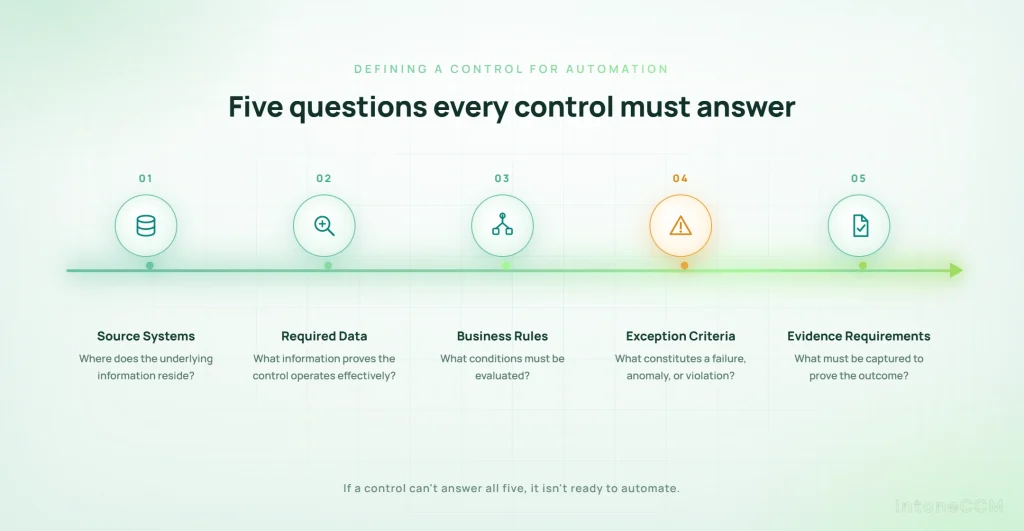
What documentation or system-generated evidence will support audit and compliance activities?
By documenting these components early, organizations provide IT with a clearer roadmap for automation and significantly reduce implementation delays.
Effective internal controls depend on clearly defined business rules, reliable data sources, and consistent monitoring processes.

Why Continuous Control Monitoring Changes the Conversation
Many organizations still rely on periodic testing and manual evidence collection. Modern control automation takes a different approach through continuous control monitoring.
Instead of waiting for quarterly reviews or annual audits, organizations can monitor control execution in near real time and identify exceptions as they occur.
Organizations pursuing SOX compliance increasingly rely on automation and continuous monitoring to improve efficiency and control effectiveness.
Modern SOX automation approaches increasingly focus on continuous monitoring, automated evidence collection, and real-time visibility to reduce manual effort and improve audit readiness.
The challenge, however, remains the same:
Continuous monitoring only works when the control’s data, rules, and exception criteria have been clearly defined.

How EagleEye365® Helps Bridge the Gap
Automation begins when everyone sees the same control through the same lens.
Control automation is not simply about replacing manual activities with software. It’s about helping compliance, internal audit, and IT teams work from a shared understanding of what a control is intended to achieve and what is required to automate it successfully.
EagleEye365® helps organizations translate control requirements into automation-ready specifications by connecting:
- Control requirements
- Source systems
- Required data
- Business rules
- Exception criteria
- Evidence collection requirements
By bringing these elements together in a single framework, EagleEye365® helps internal audit, compliance, and IT teams align early in the process and establish a common language for automation.
Instead of spending months in requirement gathering, clarification meetings, and development rework, teams can clearly define how a control should operate, what data should be evaluated, what constitutes an exception, and what evidence must be retained for audit purposes.
This structured approach helps organizations move more efficiently from control design to implementation, accelerates control automation initiatives, supports continuous control monitoring, and strengthens overall audit readiness.
Rather than repeatedly revisiting requirements throughout the development lifecycle, organizations can establish a clear and scalable path toward automation from the outset.
The Business Value of Closing the Gap
When compliance and IT teams align early, organizations can:
- Accelerate control automation initiatives
- Reduce implementation delays
- Improve audit readiness
- Eliminate excessive manual evidence collection
- Strengthen governance and control consistency
- Support continuous control monitoring programs
More importantly, control automation becomes a business initiative rather than a technology project.
The focus shifts from building controls to improving operational effectiveness, reducing compliance risk, and creating sustainable governance processes.
Properly automated controls strengthen compliance programs while supporting broader enterprise risk management initiatives.

Final Thoughts
Most organizations do not struggle because they lack automation tools. They struggle because there is often a gap between understanding what a control should accomplish and understanding what is required to automate it.
The organizations seeing the greatest success are the ones that bridge that gap early by clearly identifying source systems, required data, business rules, exception criteria, and evidence requirements before development begins.
When compliance and IT operate from a shared understanding, automation moves faster, audits become easier, and control programs become significantly more effective.
As Antoine de Saint-Exupéry wisely noted, “If you want to build a ship, don’t drum up people to collect wood and don’t assign them tasks and work, but rather teach them to long for the endless immensity of the sea.”
Ready to turn compliance requirements into automation-ready controls?
See how EagleEye365® helps compliance, audit, and IT teams accelerate automation and strengthen audit readiness.
FAQ’s
Most projects stall when control objectives are not translated into clear technical requirements such as data sources, business rules, exception criteria, and evidence requirements.
Continuous Control Monitoring automatically evaluates controls on an ongoing basis, helping organizations identify exceptions and compliance issues in near real time.
Control automation reduces manual effort, standardizes testing, and automatically captures audit evidence, making audits faster and more efficient.
Organizations should define the control objective, source systems, required data, business rules, exception criteria, and evidence requirements before automation begins.
EagleEye365® helps compliance, audit, and IT teams align on control requirements, data sources, business rules, exceptions, and evidence collection to accelerate automation and strengthen audit readiness.