
Executive Summary
Cybersecurity, data governance, and GRC are no longer adjacent functions; they are converging into a single decision-making fabric.
AI-powered threats are accelerating this shift, forcing organizations to rethink how they identify, prioritize, and manage risk.
The result:
- Cyber GRC is emerging as a real-time risk intelligencelayer
- AI is becoming foundational to both attack and defense
- Cyber risk is now indistinguishable from business risk
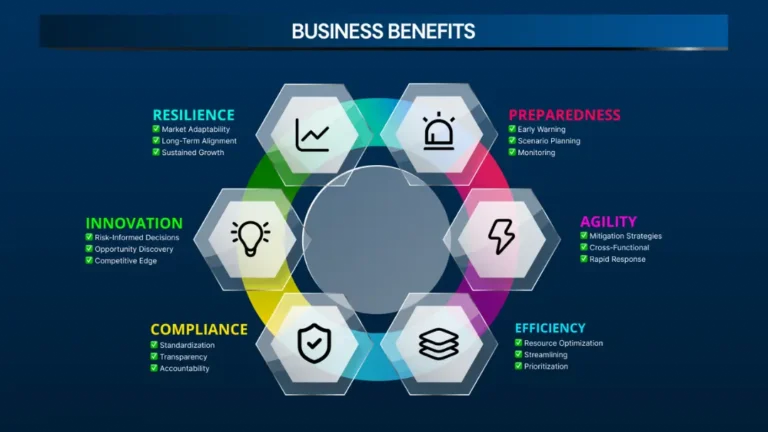
Organizations that recognize this early will shift from risk management to resilience engineering.

1. The End of Functional Silos
For years, cybersecurity and GRC operated in parallel. Security teams focused on threats, while GRC teams focused on compliance. Interaction between the two was often limited to audits or, worse, actual incidents.
That model is no longer holding up.
Today’s risk environment cuts across boundaries. A single incident can lead to operational disruption, regulatory exposure, financial loss, and reputational damage all at once. In this environment, fragmented ownership of risk creates blind spots.
What is emerging instead is a more unified approach. Cyber signals, data context, business impact, and compliance requirements are being interpreted together. This marks a fundamental shift. GRC is no longer just documenting risk; it is helping the business understand and act on it.

2. AI Has Broken the Traditional Security Model
The convergence isn’t happening in isolation; it’s being forced by the threat landscape.
AI has changed attacker economics:
- Scale is no longer a constraint
- Personalization is automated
- Execution is near real-time
Consider this:
- 40% of phishing emails are now AI-generated
- Deepfake attacks are rising across 60%+ of organizations
- Email attacks surged nearly 200% in just one year
This isn’t a minor shift; it’s a turning point.
Attackers are moving faster and operating differently, while most security models are still built for a slower pace. That gap is becoming hard to ignore.
Simply put, you can’t keep up with machine-speed threats using human-speed processes. It’s time to rethink how risk is managed—making it more continuous, connected, and responsive.

3. The Rise of AI-First Security (and Why It Changes GRC)
In response, leading organizations are not just adding AI tools; they are redesigning their security model around AI.
This is where convergence becomes real.
AI is enabling:
- Continuous risk scoring
- Cross-domain correlation (identity + data + behavior)
- Real-time prioritization based on business impact
A vulnerability is not “critical” just because it has a high score. It becomes critical when it can directly impact something that matters to the business, such as revenue, sensitive data, or customer trust. That is the real shift organizations are beginning to recognize. Instead of relying only on predefined categories or severity ratings, risk is increasingly being evaluated based on its context, specifically where it exists and what it can affect.

4. Cyber Risk Is Now Business Risk—In Real Terms
For a long time, these risks were discussed in theory, but today they are measurable. The average cost of a data breach is now $4.88 million, and AI-driven attacks are increasing both the frequency and financial impact. At the same time, regulators expect faster disclosure and greater accountability. This is changing the conversation at the top. Boards are no longer focused only on compliance; they want to understand real exposure, potential cost, and how quickly the organization can respond. As a result, the focus is shifting from technical metrics to business impact, with Cyber GRC playing a critical role in connecting the two.

5. The New Model: Cyber GRC as a Risk Intelligence Layer
The most forward-looking organizations are already moving in this direction, building a unified, AI-driven approach that connects cyber signals to business processes, aligns them with compliance, and continuously recalculates risk. This shift is changing how teams operate. Cybersecurity is becoming more predictive, GRC is evolving into a source of insight, and leadership is making more proactive decisions.
In this model, Cyber GRC takes on a much more central role as the nerve center of enterprise resilience.

6. What This Means for Leaders
This is not a tooling choice; it is a shift in how the organization is built to manage risk. Leaders need to look beyond incremental improvements and ask harder questions. Do we truly have a unified view of risk across cyber, data, and compliance, or are we still operating in silos? Are we prioritizing what matters most to the business, or just what scores highest technically? And are we using AI to make sense of risk in real time, or simply reacting after the fact?
These are not theoretical concerns. When risk visibility is fragmented, response slows down and exposure increases. The real question for leadership is straightforward. Are we equipped to keep up with how risk is evolving, or are we still relying on a model that is already falling behind?

Closing Thought
The convergence of cyber, data, and GRC is not about efficiency. It is about staying relevant in a threat landscape that moves at machine speed. Organizations that act on this shift will not just reduce risk; they will build the ability to adapt, respond, and endure. That is what resilience means today.
The question is whether you are ready to lead that shift. Start by exploring how platforms like EagleEye365®, a unified solution for real-time risk visibility and continuous control monitoring, can help you build a true enterprise risk nerve center.
FAQ’s
It is the integration of security, data governance, and compliance into a single decision-making fabric to eliminate functional silos.
AI has accelerated threat speed and scale, making traditional human-speed processes insufficient for modern risk management.
Breaches now carry massive financial and regulatory consequences, shifting the focus from technical metrics to total business impact.
It provides a unified platform for real-time risk visibility and continuous control monitoring across the enterprise.
Yes, it enables continuous risk recalculation by correlating identity, data, and behavior to prioritize threats based on business impact.