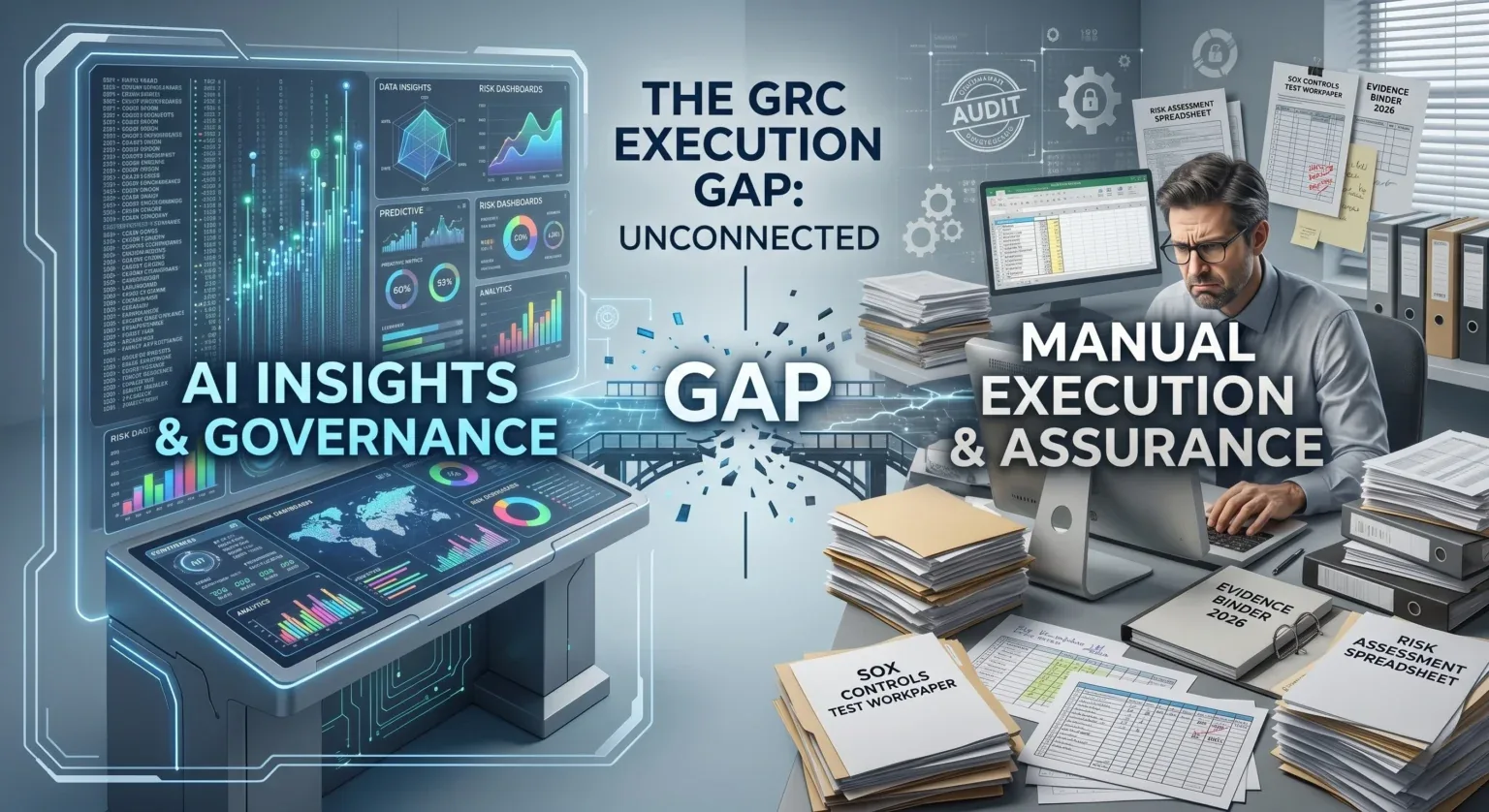
Your GRC program has adopted AI. Your controls are still being tested by hand. Your evidence still piles up in spreadsheets. Your board still waits three weeks for risk data. This is the execution gap — and it is the most expensive problem in enterprise compliance that no one is talking about directly.
AI accelerates insight. It does not — on its own — deliver assurance. And in 2026, confusing the two is the most dangerous mistake a GRC leader can make.
Let’s start with the uncomfortable truth that most vendors aren’t saying out loud: the majority of organizations that have invested in AI-powered GRC tools are still not producing continuous, audit-ready outcomes. Their AI is generating summaries, drafting narratives, flagging anomalies, and surfacing recommendations — and then handing all of that back to an analyst who manually tests a sample, collects evidence in a shared drive, and produces a workpaper three weeks before the audit window closes.
That is not a criticism of AI. It is a structural observation about where AI stops and execution begins — and the gap between those two points is exactly where most GRC programs are quietly losing time, losing money, and accumulating risk they cannot see.
Definition
The GRC Execution Gap is the space between what AI-powered tools can analyze, suggest, and surface — and what actually gets tested, documented, evidenced, and proven to an auditor, a regulator, or a board. Every GRC program has one. Most leaders don’t know how wide theirs is.
The Promise of AI in GRC — and Where It Stops
There is no shortage of AI capability being marketed into the GRC and internal audit market right now. Microsoft Copilot accelerates productivity, drafts controls, and summarizes documentation. Claude AI generates insights, evaluates risks, and assists in policy design. Every major platform — from Workiva to Optro (formerly AuditBoard) to Vanta — has AI embedded at the workflow level. The technology is real, it is useful, and the firms deploying it are moving faster than those that aren’t.
But here is what the marketing materials rarely say: AI is an insight generator, not an execution engine. There is a critical list of things that AI copilots, on their own, cannot do:
- Connect to your ERP and pull every journal entry posted last quarter
- Execute your approval control across 100% of that population — not a sample
- Flag, in real time, every transaction where the exception criteria were met
- Automatically generate the workpaper, attach the supporting evidence, and link it to the control
- Produce an audit-ready documentation package that your external auditor can rely on without qualification
Those five steps are not AI problems. They are execution problems. And they are the steps where most organizations are still doing the work manually, at enormous cost in time, people, and audit exposure.
| 4 – 8 | Weeks. That is how long compliance teams routinely spend preparing for regulatory exams and internal audits — evidence gathering, narrative drafting, cross-referencing controls to obligations — consuming analyst time that should go toward proactive risk management. AI can compress the drafting work. Only an execution platform eliminates the gathering work entirely. |
What the Gap Looks Like in Practice
Consider how a typical SOX control is tested today, even in organizations that have adopted AI tools. A management review control (MRC) requires a reviewer to examine the general ledger variance report, identify and investigate any fluctuations above the threshold, and document their analysis. Your AI drafts the control description beautifully. It even generates a suggested testing approach.
Then what happens?
An analyst opens the ERP. Exports the report to Excel. Runs the threshold filter manually. Identifies the exceptions. Screenshots the supporting approvals. Saves them to a SharePoint folder with an inconsistent naming convention. Writes a narrative in a Word document. Sends it to a manager for review via email. Receives it back with track changes. And finally — if everything goes right — produces a workpaper that two weeks later a senior auditor reviews and asks a clarifying question about. Which triggers another round of evidence requests.
That is not a fictional worst case. That is the standard operating procedure at the majority of mid-market and enterprise organizations. And it persists not because the team isn’t working hard, but because the tools they have were never designed to bridge the execution gap. They were designed to accelerate the thinking. Not to complete the doing.
The PCAOB Signal
The PCAOB’s most recent inspection findings have explicitly called out IPE — Information Produced by the Entity — as a recurring deficiency area. When auditors ask whether the reports used in your controls are complete, accurate, and free from manipulation, the organization that can produce a validated data lineage trail and automated evidence package answers in minutes. The organization relying on manual processes answers in days — or can’t answer at all.
The Anatomy of the Execution Gap: AI vs. Execution
This is not a comparison that diminishes the value of AI insight tools. Copilot and Claude are genuinely powerful accelerators for GRC professionals. The point is that they are the beginning of the workflow, not the end. And the organizations that treat them as the end are accumulating execution debt with every audit cycle.
The organizations that will win in audit quality in 2026 are not the ones that adopted AI the fastest. They are the ones that understood where AI stops — and built an execution layer to finish the job.
| EagleEye365 by IntoneCCM |
Closing the Gap: How EagleEye365 Completes the Assurance Cycle
EagleEye365 from IntoneCCM was built from a single foundational premise: enterprise AI needs an execution layer. AI accelerates insight generation — drafting, summarizing, analyzing. EagleEye365 delivers continuous assurance — connecting, executing, monitoring, and proving. The two work together. Neither works without the other.
Here is how EagleEye365 closes the execution gap across each stage of the GRC and audit lifecycle:
| 1 | AI-Assisted Control Drafting → Structured Control Attributes Your AI tool — Copilot, Claude, or your platform’s embedded AI — drafts or refines the control description. EagleEye365 takes that draft and converts it into a structured, testable set of control attributes: population criteria, exception logic, evidence requirements, and approval workflow definitions. The bridge from human language to executable logic is built automatically. |
| 2 | ERP & Workflow System Integration EagleEye365 connects directly to your source systems — SAP, Oracle, Workday, Dynamics, ServiceNow, identity platforms, approval workflow tools — pulling the transaction data that the control is designed to govern. No manual exports. No analyst with an Excel file. The data flows directly into the execution engine, continuously. |
| 3 | 100% Population Testing — Not Sampling EagleEye365 executes the control across every transaction in scope — not a representative sample. When the PCAOB or your external auditor asks whether the journal entry approval control was operating effectively last quarter, the answer isn’t “we tested 25 items.” It’s “we tested 47,832 items, and here are the 14 exceptions we identified and remediated in real time.” That is a fundamentally different audit conversation. |
| 4 | Real-Time Exception Flagging with Supporting Evidence When the control logic identifies an exception — a transaction approved outside authorization limits, a segregation of duties conflict, an access event that doesn’t match the policy — EagleEye365 flags it in real time, attaches the supporting evidence, and routes it to the appropriate control owner for review and remediation. Exceptions are resolved when they occur, not discovered during audit preparation. |
| 5 | Automated Audit-Ready Documentation EagleEye365 produces the workpaper automatically — control attributes, population tested, exceptions identified, evidence attached, remediation documented, and conclusions drawn. The output isn’t a narrative that needs to be formatted into a workpaper. It is the workpaper, already organized, linked, and ready for auditor review. Audit preparation stops being a sprint and starts being a status check. |
Enterprise System Integration
Pre-built connectors to SAP, Oracle, Workday, Dynamics 365, Okta, ServiceNow, and 30+ additional enterprise systems — no custom integration required.
Full Population Testing
Test 100% of transaction populations continuously — eliminating sampling risk and the statistical uncertainty that drives auditor skepticism.
Real-Time Exceptions & Alerts
Exceptions surface the moment they occur, with evidence attached and ownership routed — converting reactive remediation into proactive control management.
Audit-Ready Evidence Packages
Automated workpapers, data lineage documentation, IPE validation packages, and board reporting — generated continuously, not assembled in a pre-audit sprint.
Embedded AI Intelligence
AI-assisted control structuring, intelligent workpaper annotations, AI-driven exception analysis, and audit workflow acceleration — inside the execution layer, not alongside it.
Board-Ready Risk Reporting
Real-time dashboards sourced from live control data — giving your board and audit committee the risk visibility they expect, without the three-week lag your current process creates.
The Business Case: What Closing the Execution Gap Is Actually Worth
The execution gap has a carrying cost that most organizations have never quantified, because it is distributed across so many teams and cycles that no single line item captures it. But when you add it up, the numbers are significant.
Quantified Impact
Organizations implementing continuous controls monitoring achieve 40–60% reductions in median fraud losses — from over $200,000 to approximately $100,000–$120,000 — per the Association of Certified Fraud Examiners’ 2024 Report. That is not the cost of the platform. That is the cost of not having it.
External audit fee reduction. External auditors charge for time spent on evidence review, inquiry, and re-performance. When your evidence package is automated, organized, and pre-linked to controls, that time compresses materially. Organizations that have moved to continuous controls monitoring consistently report reductions in external audit support hours of 25–40%.
Internal resource reallocation. The 4–8 weeks that compliance analysts currently spend preparing for audits can be redirected to higher-value advisory and risk analysis work — directly addressing the talent and capacity crisis the IIA has identified as the profession’s most urgent challenge.
Deficiency prevention. Every material weakness or significant deficiency is a restatement risk, an auditor trust problem, and a remediation cost. The PCAOB’s own inspection data shows that organizations with persistent control deficiencies attract more intensive inspection scrutiny — a compounding cost that continuous monitoring directly breaks.
Regulatory response speed. When a regulator asks for evidence of control effectiveness over the prior 18 months, the organization with EagleEye365 produces a complete, continuous evidence trail in hours. The organization relying on point-in-time testing produces a partial picture in days — or escalates to a remediation posture it cannot afford.
| 18% | Only 18% of organizations are fully confident they could pass an independent review of their AI controls in the next 90 days — per Grant Thornton’s 2026 AI Impact Survey. The execution gap isn’t limited to traditional GRC controls. It extends to the AI programs every organization is now deploying. EagleEye365 addresses both. |
Why This Matters More in 2026 Than It Did Last Year
The execution gap has always existed. But three developments in 2025 and 2026 have simultaneously widened its consequences for organizations that haven’t addressed it.
The IIA’s New Global Standards Have Raised the Bar
The IIA’s 2025 overhaul of the Global Internal Audit Standards is not a procedural update. It fundamentally reframes what a conforming internal audit function is required to do — elevating expectations for strategic alignment, stakeholder engagement, continuous monitoring, and performance measurement. The new Topical Requirements on Cybersecurity (effective February 2026) and Third-Party Risk (September 2025) set minimum baselines that point-in-time, manual programs cannot credibly meet. Conformance now requires continuous assurance capability — not just a stronger methodology document.
PCAOB Scrutiny Has Never Been More Targeted
The PCAOB’s 2025 inspection priorities explicitly named IT-sector control challenges, AI use, crypto exposure, and management review control design as areas of focus. Inspectors are challenging whether organizations have updated their ITGCs and MRCs to reflect actual current-state business processes — including cloud migrations, AI tool deployments, and shared service restructuring. The organizations that have continuous, documented evidence of control operation are positioned to answer those questions. The organizations with point-in-time documentation are not.
Boards Are Done Waiting for Risk Data
The 2026 “What Directors Think” report from Corporate Board Member and Diligent Institute found that only 8% of directors report having strong AI expertise on their boards. But that same group of directors is increasingly demanding real-time, financially quantified risk visibility — not a slide deck built from a quarterly rollup. The execution gap is precisely what prevents GRC functions from delivering that visibility. Closing it is not a technology project. It is a governance credibility project.
The Strategic Imperative
Internal audit and GRC functions that close the execution gap in 2026 will enter 2027 operating as strategic assets — providing real-time assurance, proactive risk intelligence, and board-level confidence. Functions that don’t will spend 2027 preparing for audits, managing deficiencies, and explaining to leadership why their AI investment hasn’t changed the outcome.
Where to Start: A Practical Path to Closing Your Execution Gap
The execution gap does not need to be addressed all at once. The most effective approach is to identify the highest-risk area of your control environment where point-in-time testing is creating the most exposure — and start there. For most organizations, that means one of three places:
| A | Journal Entry and Financial Close Controls The highest-volume, highest-risk area for most SOX programs. If your journal entry approval control is still being tested on a sample of 25 items from a population of 50,000, the execution gap here is significant — and auditor scrutiny on late-posted, manually approved, and unusual entries is intensifying. |
| B | User Access and Segregation of Duties Controls Access accumulates. Roles expand. SoD conflicts compound silently. Continuous monitoring of access against your defined conflict matrix — with real-time alerting when an incompatible role combination appears — closes one of the most persistent and damaging categories of control deficiency. |
| C | IPE Validation and Report-Reliant Controls If PCAOB has raised IPE as a finding in your most recent audit cycle, this is your highest-urgency starting point. EagleEye365’s IPE validation capability inventories your key reports, validates completeness and accuracy, documents data lineage, and produces the validation package your external auditors need to rely on those reports without qualification. |
Each of these starting points delivers immediate, measurable value — and each creates the foundation for expanding continuous controls monitoring across your full program over subsequent quarters.
The Bottom Line
The GRC market has embraced AI. That is not in question. The question for 2026 — and the question that will separate high-performing compliance programs from struggling ones — is whether AI adoption has been matched by execution capability. Whether the insights that AI surfaces are being operationalized into controls that execute, evidence that is collected automatically, and outcomes that auditors can rely on.
The execution gap is where good GRC intentions meet operational reality. It is where the ROI on your AI investment either materializes or evaporates.
EagleEye365 from IntoneCCM exists to close that gap. Not to replace your AI tools — but to complete what they start. To connect insight to proof. To convert continuous monitoring from a concept into a documented, auditable, board-reportable reality.
If your program has invested in AI and is still experiencing the same audit cycle pressure, the same evidence scramble, the same point-in-time exposure — the problem is not your team and it is not your AI. It is the missing layer between them.
That layer is EagleEye365. And the conversation about closing your execution gap starts with a 30-minute briefing that we would welcome the opportunity to have with you.
IntoneCCM Editorial & EagleEye365 Practice Team
GRC Advisory · Continuous Controls Monitoring · Intone Networks, Inc.
IntoneCCM is the GRC and compliance technology practice of Intone Networks, Inc., delivering continuous controls monitoring, audit-ready execution, and AI-enabled assurance through the EagleEye365 platform. Our practice team includes former Big 4 audit practitioners, GRC technology architects, and internal audit leaders with experience across financial services, healthcare, manufacturing, and public sector organizations.