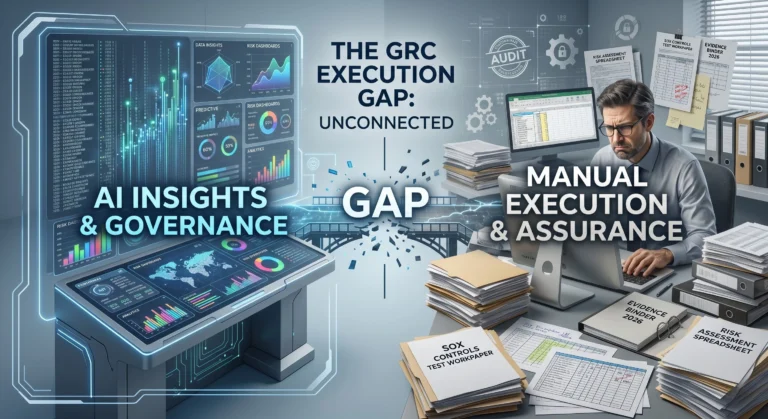

Continuous Controls Monitoring (CCM) has become one of the most discussed initiatives in compliance, SOX, and Internal Audit programs.
Yet despite significant investments in dashboards, analytics, and workflow tools, many organizations still struggle to move beyond periodic reporting and manual testing.
The reason is simple.
Most organizations never translate the actual control review process into executable logic.
Read on in this blog to understand where most CCM initiatives break down and how organizations can operationalize controls for scalable, continuous monitoring.
The Real Problem With CCM
Many companies approach CCM as a data integration initiative.
They focus on:
- Connecting systems
- Centralizing data
- Building dashboards
- Creating alerts and workflows
While those capabilities are important, they do not actually execute controls.
They simply organize information.
The real challenge is operationalizing how reviewers evaluate risk and determine whether a control operated effectively.
The Hidden Problem Inside Manual Controls
Most controls appear straightforward on paper.
A control description may state that management reviews journal entries, validates user access, or approves system changes prior to deployment.
But the most important part of the control is often undocumented.
It exists in the reviewer’s judgment.
For example, a reviewer may evaluate:
- Whether approval occurred prior to posting
- Whether the approver was authorized
- Whether segregation of duties conflicts exist
- Whether supporting documentation is sufficient
- Whether unusual activity requires escalation
These decisions are rarely documented in a structured way.
As a result, organizations struggle to automate or continuously monitor the control consistently.
Why Most CCM Initiatives Stall
This is where many CCM projects lose momentum.
Organizations successfully connect data sources but never define the underlying control logic required to execute testing at scale. Without this logic, the monitoring framework has no way to translate data into meaningful control evaluation.
The result:
- Dashboards without actionable insight
- Alerts without context
- Continued reliance on manual testing
- Inconsistent reviews
- Sample based testing instead of full population monitoring
Data connectivity is foundational.
Executable control logic is transformational.
Operationalizing Continuous Controls Monitoring
Organizations that successfully implement CCM take a different approach.
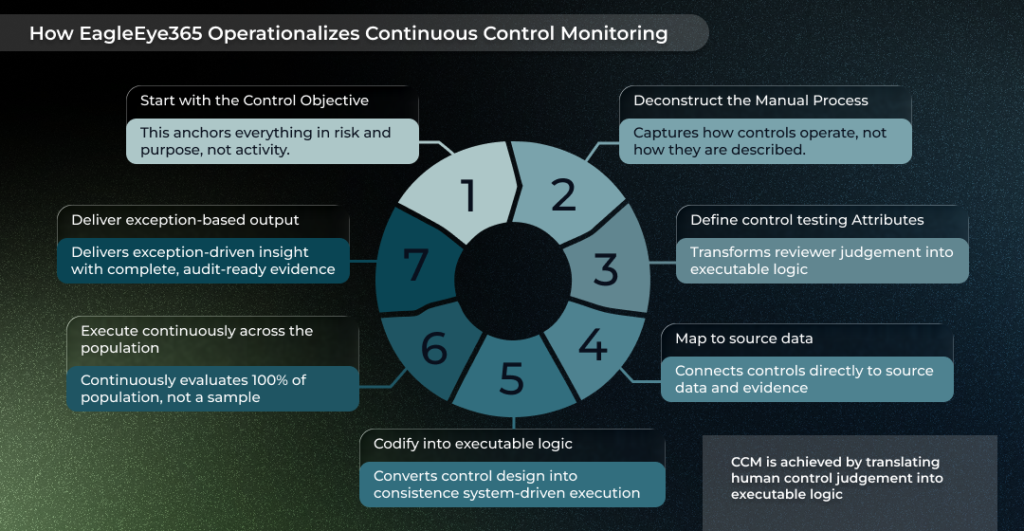
They focus on operationalizing the control itself by:
- Defining the control objective
- Breaking down the manual review process
- Identifying testing attributes and decision criteria
- Mapping evidence and source data
- Translating reviewer judgment into executable logic
- Executing testing across the full population
- Delivering real time exception visibility and monitoring
This is the difference between digitizing compliance activities and truly operationalizing Continuous Controls Monitoring.
How EagleEye365® Helps
EagleEye365® was designed to address this challenge.
Rather than focusing only on dashboards and workflows, the platform helps organizations translate manual control execution into structured, repeatable monitoring logic.
By combining data connectivity, evidence management, transaction level monitoring, and automated testing logic, organizations can move beyond periodic reviews and toward scalable, continuous risk monitoring.
Executive Summary
Continuous Controls Monitoring (CCM) is widely discussed but poorly executed. Despite increased investment, many organizations remain trapped in manual, sample-based control testing that fails to scale with risk.
Industry data shows:
- Most organizations still rely on judgmental, sample-based testing, limiting coverage and increasing cost
- 95% of CISOs say their programs are not optimized for continuous improvement
The core issue is not data access; it’s the failure to translate human control judgment into executable logic.
Organizations that succeed with CCM operationalize how controls are actually reviewed, monitored, and evaluated in practice.
Final Thought
Continuous Controls Monitoring is not achieved simply by connecting systems or visualizing data.
It is achieved when organizations can consistently replicate how controls are actually evaluated and executed in practice. That is what transforms CCM from a reporting exercise into a scalable risk and compliance capability.
Explore how EagleEye365® is redefining what effective CCM looks like in practice.
CCM is the continuous, automated testing of controls to confirm they operate effectively across entire populations, not samples.
They connect data but fail to convert manual control judgment into executable logic, preventing consistent testing at scale.
Traditional testing is periodic and sample‑based. CCM runs control testing continuously across full populations.
EagleEye365® translates manual controls into structured, executable logic for continuous monitoring and real‑time exceptions.
No. It automates routine testing so teams can focus on investigation, risk analysis, and remediation.