
Organizations today are not struggling to interpret compliance requirements. They are struggling to operate efficiently within them.
Most companies must align with multiple frameworks, including SOC, NIST, ISO 27001, GDPR, and others. Each introduces its own structure and terminology. On paper, they appear distinct. In practice, they often address the same underlying risks.
Yet inside most organizations, compliance is still executed by framework.
The result is predictable:
- The same control is documented multiple times.
- The same evidence is requested repeatedly.
- The same testing is performed in parallel cycles.
- Audit teams spend more time coordinating than evaluating.
This is not a compliance problem. It is an operating model problem.
The Hidden Inefficiency: Controls Are Reused, Work Is Not
When you step back, reality becomes clear.
Most controls are not unique to a single framework.
A user access review, change management process, or reconciliation control often satisfies multiple frameworks at once. The underlying risk does not change. Only the language describing it does.
However, because frameworks are managed independently:
- Controls are recreated under different naming conventions.
- Testing is duplicated across audit cycles.
- Evidence is collected multiple times for the same activity.
Over time, this creates an unnecessary burden on both audit teams and the business.
More importantly, it obscures visibility. When the same control exists in multiple places, it becomes difficult to answer:
Do we actually know how this control is performing across the organization?
Why Traditional Mapping Falls Short
Many organizations recognize this challenge and attempt to address it through manual control mapping.
While directionally correct, these efforts often stall for three reasons:
1. Complexity – Frameworks are structured differently, making one-to-one mapping difficult without deep expertise.
2. Maintenance Burden – As frameworks evolve, mappings quickly become outdated and require ongoing manual updates.
3. Lack of Operational Integration – Mappings are rarely embedded into day-to-day workflows. Testing and evidence collection still occur separately.
As a result, mapping becomes a static exercise rather than a living capability.
A Shift in Approach: From Framework-Centric to Control-Centric
A more effective model is to rethink how compliance is structured.
Instead of managing compliance through frameworks, organizations should manage it through controls.
This reflects the core foundation of what has been developed within EagleEye365®.
EagleEye365® establishes a common control framework that aligns with regulatory requirements. In this model:
- Controls are defined once, based on the risk they address.
- Testing is executed once.
- Evidence is collected once and tied to control performance.
- Frameworks are mapped back to those controls.
This creates a single source of truth for control of execution.
Rather than asking, “How do we comply with this framework?” Organizations operating in EagleEye365® ask, “How do our controls perform across all frameworks in real time?”
How EagleEye365® Uses AI to Solve the Mapping Challenge
Historically, building and maintaining a common control framework at a scale has been difficult. It requires continuous interpretation, updates, and alignment.
EagleEye365® addresses this through AI-driven mapping.
Organizations can upload their frameworks and control sets. AI agents then:
- Analyze framework structure and intent.
- Identify overlapping control objectives.
- Map controls across multiple requirements.
- Highlight redundancy and consolidation opportunities.
- Surface gaps in coverage.
“This is not a one-time exercise. Mapping becomes continuous and embedded within the compliance lifecycle.”
From Duplication to Efficiency and Insight
When organizations adopt a control-centric model within EagleEye365®, the impact is immediate.
Reduced Redundancy – Controls are tested once, with results applied across frameworks.
Streamlined Evidence Collection – Evidence is automatically captured across systems, eliminating repetitive requests.
Consistency in Execution – Control definitions and testing are standardized across frameworks.
Faster Framework Adoption – New requirements can be addressed by mapping to existing controls.
Improved Visibility – Leadership gains a unified, real-time view of compliance and risk.
Beyond Efficiency: Continuous Controls Monitoring in Practice
The advantage of EagleEye365® is not just mapping. It is operationalizing controls through continuous monitoring.
Instead of periodic testing:
- Controls are tested continuously across full populations.
- Exceptions are identified in real time.
- Evidence is automatically captured and audit ready.
- Remediation workflows are triggered and tracked.
This shifts compliance from a retrospective process to a real-time capability.
Audit teams move away from manual validation and focus on exceptions and emerging risks.
The Risk of Maintaining the Status Quo
Organizations that continue to manage compliance in silos face increasing pressure.
As data volumes grow and expectations evolve:
- Manual testing is becoming less reliable.
- Audit fatigue increases.
- Costs rise without improving coverage.
- Visibility into true risk of exposure remains limited.
Without a unified approach, compliance becomes more expensive while delivering less insight.
A More Scalable Path Forward
Multi-framework compliance will continue to expand.
The organizations that succeed will not simply keep up with requirements; they will rethink how compliance is executed.
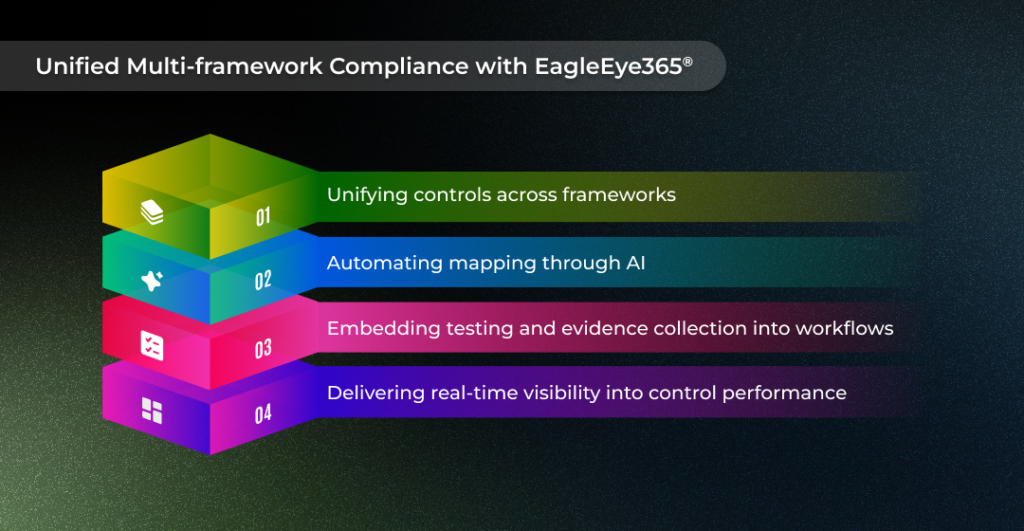
EagleEye365® enables this by:
- Unifying controls across frameworks
- Automating mapping through AI
- Embedding testing and evidence collection into workflows
- Delivering real-time visibility into control performance
This transforms compliance into a scalable, intelligent system.
Executive Takeaway
For executives and audit leaders, the path forward is clear:
- Move away from framework-by-framework execution.
- Establish a common control framework.
- Leverage AI to continuously align and optimize controls.
- Adopt continuous monitoring to improve coverage and confidence
Organizations that make this shift will reduce cost, improve efficiency, and strengthen trust.
That is the role EagleEye365® is designed to play.