Beyond the Buzz
AI agents are quickly becoming one of the most talked-about topics in SOX compliance and internal audit. Yet in many conversations I have with audit leaders, the same question keeps coming up: what do these agents actually do in practice? This blog breaks down where AI agents truly add value, where they do not replace human judgment, and how they are beginning to reshape day-to-day audit operations.
What AI Agents Actually Do: The Operational Backbone
AI agents handle operational tasks that often slow audit teams:
- Evidence aggregation across fragmented systems.
- Completeness checks on documentation and control testing.
This extends beyond automation to capacity creation. In practice, this might look like an AI agent monitoring user-access changes across systems, automatically checking segregation-of-duties conflicts, attaching supporting evidence, and routing remediation tasks to control owners. Instead of performing routine validation, auditors focus on reviewing the exceptions that matter.
For instance, Gartner’s 2024 survey of Chief Audit Executives reported that 41% of internal audit teams are already using or planning to use generative AI, with the primary benefits being faster insights, improved audit writing, and freeing auditor time for higher‑value activities.
What They Don’t Do: Guardrails for Trust
Executives should recognize the limitations:
- AI agents do not exercise judgment.
- They do not sign off on controls.
- They do not replace governance structures.
Instead, they enhance team effectiveness and accelerate execution. However, the board and audit committee retain responsibility for trust and accountability.
Governance Still Matters: The Trust Architecture
Automation without governance compromises safety. Regulators emphasize that workflows, approvals, and audit trails are essential requirements.
Learn why data lineage and auditor trust in SOX automation are becoming critical factors in achieving auditor reliance on automated controls. Executives play a critical role in designing structures that balance innovation with oversight. This framework includes essential elements such as data lineage tracking to maintain data integrity across systems, a model validation cadence to assess AI models for efficacy and compliance regularly, and clear documentation of decision-making processes to enhance traceability and accountability.
The Value Proposition: ROI Meets Resilience
When deployed responsibly, AI agents deliver measurable impact:
- Efficiency: Streamlining evidence collection and repetitive testing.
- Reliability: Reducing human error and increasing consistency.
The economic case is clear. The 2025 KPMG SOX Survey shows U.S. public companies spend an average of $2.3 million annually on SOX audit services, with internal costs often ten times higher. AI agents can cut these expenses while strengthening compliance and resilience. Even modest efficiency improvements can translate into meaningful cost savings over time while improving testing coverage and consistency..
What you need to know about our AI SOX Compliance Agent
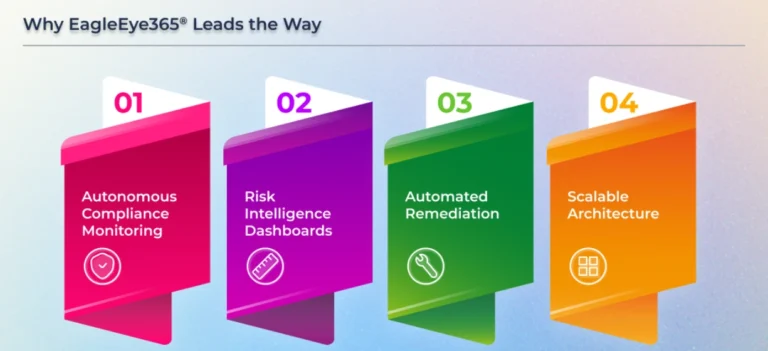
In environments like EagleEye365®, AI-driven SOX compliance agents help shift compliance from periodic, sample-based testing to continuous monitoring. They connect to enterprise systems, automate control testing, collect audit-ready evidence, and provide real-time visibility into exceptions and remediation progress.
In practice, audit preparation time is reduced by half, and over 60% of manual testing is eliminated. Every transaction is continuously monitored, while automated evidence collection, predictive risk scoring, and faster reporting streamline the workflow. As a result, audit teams gain valuable time to focus on strategic risk management, thereby strengthening regulatory confidence and organizational agility.
Equally important, EagleEye365® ensures that evidence remains verifiable and trustworthy. Every data point is tied back to its original source through audit trails, while human in the loop validation provides an added safeguard against AI “hallucinations.” This means auditors can always trace and confirm the integrity of the evidence, reinforcing confidence in both the process and the outcomes.
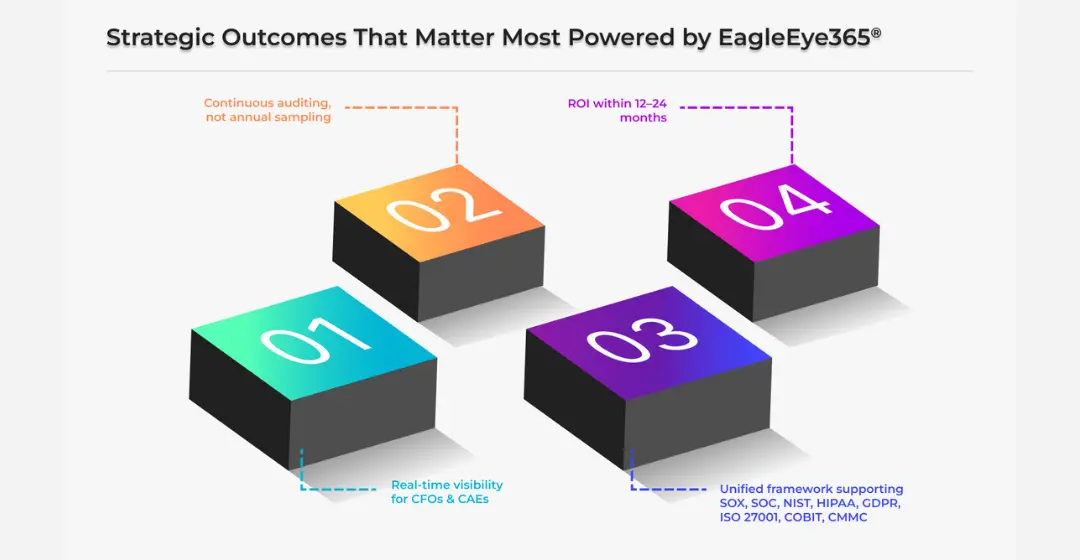
Strategic Outcomes That Matter Most Powered by EagleEye365®
– Real-time visibility for CFOs & CAEs
– Continuous auditing, not annual sampling
– Unified framework supporting SOX, SOC, NIST, HIPAA, GDPR, ISO 27001, COBIT, CMMC
– ROI within 12–24 months
The Risk of Standing Still
Manual approaches may feel familiar, but they are increasingly unsustainable. As data volumes grow and regulators demand faster, more transparent reporting, samplebased testing leaves organizations exposed. Costs continue to rise, while inefficiencies compound across fragmented systems.
Relying on manual methods puts organizations at a disadvantage compared to peers adopting continuous monitoring. This approach leads to slower responses, reduced coverage, and lower regulatory confidence. In contrast, AI-enabled audit teams improve speed, resilience, and credibility, making compliance a strategic advantage.
A Way Forward
AI agents in SOX and Internal Audit are not the auditors of tomorrow—they are the partners of auditors today. Tom McLeod, former Chief Audit Executive and Chief Risk Officer, emphasizes in one of his posts that success with AI agents in audit depends not only on building them but also on managing them as a cohesive team.
It will be important to assess both the capabilities of these agents and the ways auditors can organize, supervise, and learn from them.
Used wisely, they help organizations move faster, stay accountable, and build resilience in an increasingly complex regulatory landscape.
Executive Takeaway
AI agents in SOX and internal audit are not intended to replace auditors, but to enhance their roles. By handling routine tasks, they enable professionals to focus on judgment, insight, and building trust. To foster this transformation, executives should start by identifying a pilot process ripe for AI integration. What current, repetitive tasks in your operations could benefit most from automation? By pinpointing these early opportunities and developing a tailored adoption roadmap, organizations can quickly gain traction and ensure that the shift to enhanced digital capabilities aligns with strategic goals.
For executives, the mandate is clear:
- Deploy AI agents responsibly.
- Anchor them in governance frameworks.
- Leverage them to shift compliance from a cost to a credibility driver.
- AI agents succeed when managed like a team, not just built as tools.
By doing so, organizations increase efficiency, maintain accountability, and build resilience in an environment where trust is essential for business success.
No. AI agents handle repetitive tasks but do not replace human judgment in risk assessment or decision-making.
They support evidence collection, completeness checks, and follow-ups, but governance controls (approvals, audit trails) remain essential.
Not in terms of headcount for critical functions. They reduce manual workload, allowing auditors to focus on higher-value tasks.
Key risks include over-reliance on automation, lack of governance oversight, and potential gaps in accountability if workflows are not properly designed.
By insisting on clear governance frameworks, transparent audit trails, and alignment with compliance standards before adoption.