Introduction
Enterprise Risk Management (ERM) will have evolved from a back-office task into a boardroom priority. Organizations today are actively elevating ERM as a strategic discipline that informs decision making and governance.
Escalating pressures, such as AI-driven cyber threats, supply chain disruptions, operational breakdowns, and financial volatility, have increased organizational vulnerability.
Surprisingly, 65% of executives and board members report that their companies are not fully prepared for emerging risks, according to insights from the 14th Annual Executive Risk Survey by the NC State ERM Initiative and Protiviti. In this environment, ERM is no longer a choice; it is a strategic necessity. It consolidates risk domains into proactive governance for resilience and growth.
Let us explore the strategic value of ERM and how it enables governance transformation.
Defining ERM Beyond Compliance
Risk management once meant checklists and reactive fixes. Today, threats are increasingly concentrated and interconnected. Envision a risk ecosystem where cyber, ESG, and financial risks interact like a web, with changes in one area influencing the others. Navigating this web requires a proactive, holistic strategy that goes beyond compliance, and supports organizational resilience and sustainable growth.
To achieve this shift, organizations must embed ERM into the very fabric of their operations. What does that mean? It means assigning clear responsibilities, escalating issues promptly, and allocating resources strategically. These concrete actions foster cultural alignment and strategic integration.
Core Strategies for Effective ERM
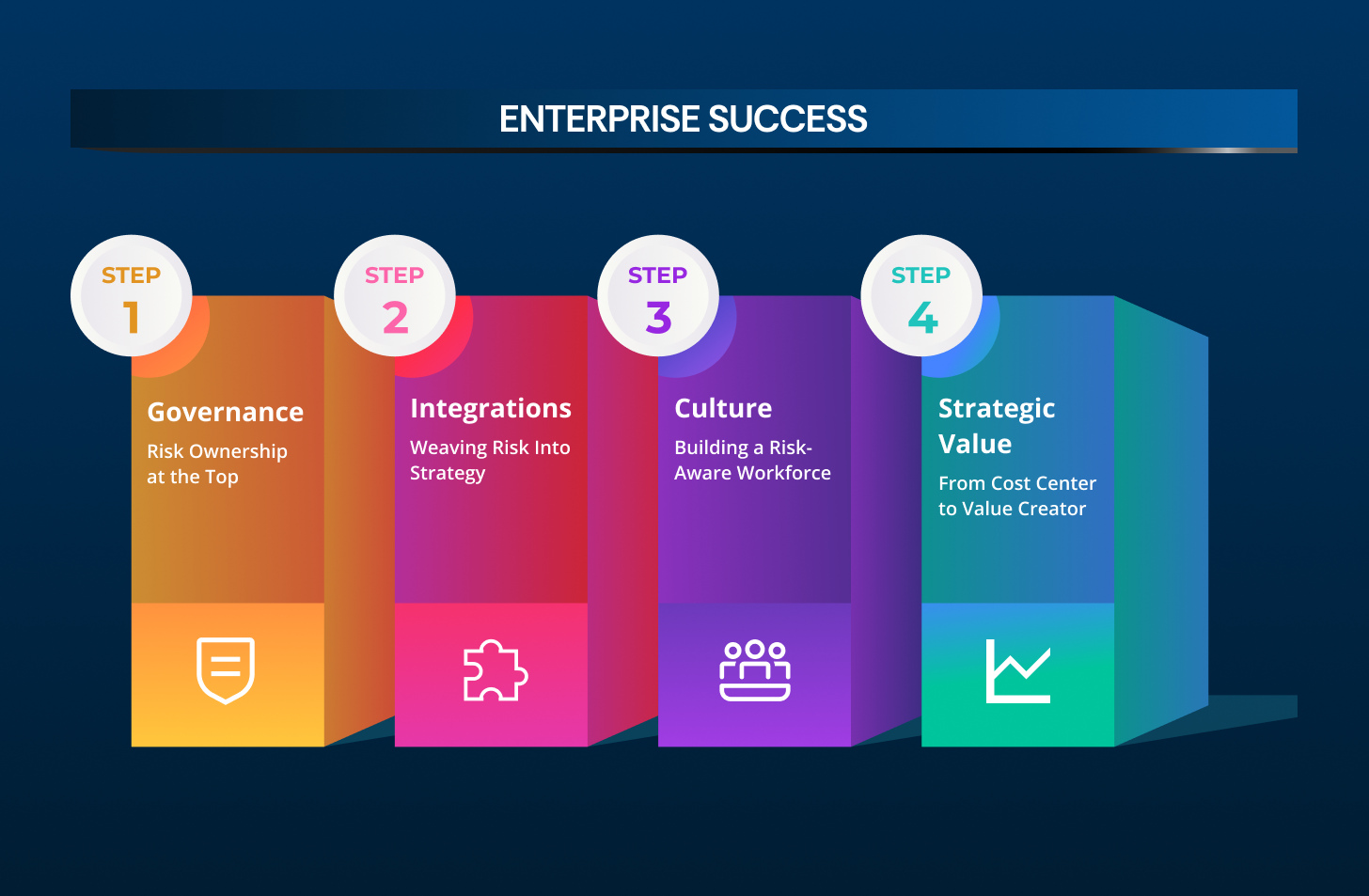
- Governance: Risk Ownership at the Top
The foundation of a robust ERM program lies in governance. When roles and responsibilities are clearly established across both the board and executive leadership, risks are not only recognized but also assigned to the appropriate stakeholders for effective ownership and management. This arrangement prevents blind spots and boosts transparency, making risk management a shared responsibility across the organization.
- Integration: Weaving Risk Into Strategy
Visionary leaders don’t view risk as an isolated issue. They embed risk assessments into strategic planning, performance metrics, and resource allocation. By integrating risk and resilience into business processes, organizations transform risks into untapped opportunities and strengthen long-term competitiveness.
- Culture: Building a Risk-Aware Workforce
An ERM strategy is only as effective as the culture supporting it. A risk-aware culture empowers employees at every level to recognize, escalate, and proactively mitigate risks. This cultural shift ensures risk management is embedded across the enterprise rather than confined to leadership.
Strategic Value: From Cost Center to Value Creator
ERM has evolved into a strategic enabler. The percentage of organizations with complete ERM processes has grown significantly, reflecting its role in resilience and sustainability. When governance, integration, culture, and strategy align, ERM shifts from being a compliance-driven cost center to a creator of long-term value.
Benefits of ERM for High-Maturity Organizations
- Preparedness
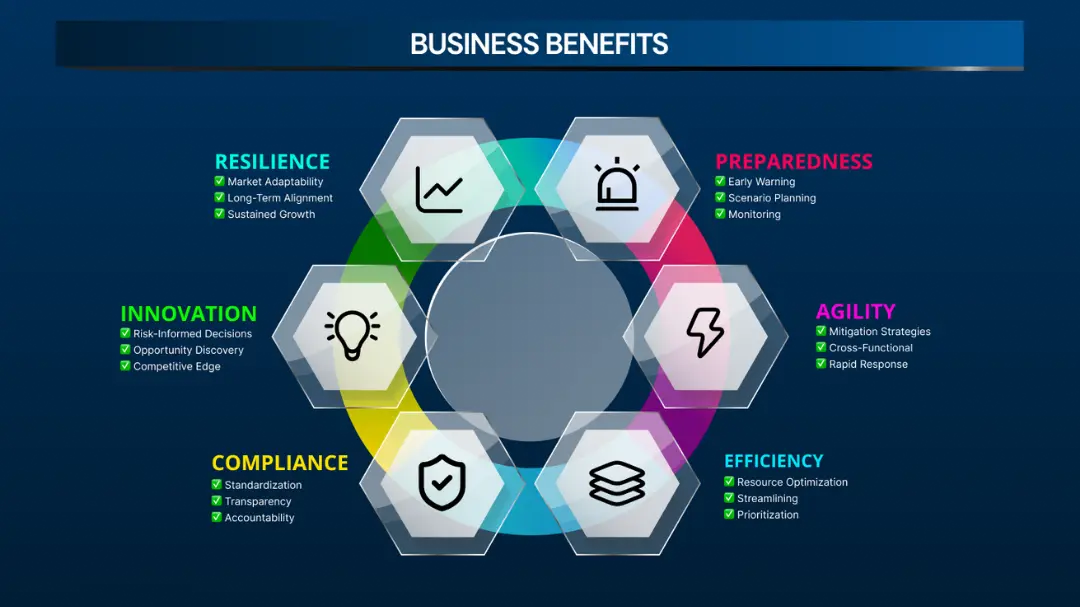
ERM uses predictive tools such as early warnings, scenario planning, and stress testing to identify, assess, and respond to risks, supporting ongoing monitoring and preparedness for new challenges.
- Agility
ERM follows predefined strategies such as avoidance, mitigation, transfer, or acceptance, depending on risk severity. Cross-functional collaboration enables rapid, precise, and coordinated responses across the enterprise.
- Efficiency
By minimizing duplication of efforts across departments, ERM improves operational efficiency. Clearer visibility allows organizations to allocate resources effectively, streamline processes, and prioritize initiatives that deliver the highest value.
- Compliance
Automated monitoring and standardized reporting reduce the burden of regulatory requirements. This structured approach enhances transparency and accountability, building trust with regulators, investors, and stakeholders.
- Innovation
ERM enables risk-informed decisions that balance bold strategies with calculated safeguards. Risks are reframed from potential threats into opportunities for innovation, giving organizations a competitive edge.
- Resilience
ERM embeds risk awareness into strategic planning, empowering leaders to pivot quickly in volatile markets. By aligning risk intelligence with long-term goals across cybersecurity, ESG, finance, regulation, and operations, organizations achieve resilience and sustained growth.
(Infographic idea: Benefits wheel with six segments — Preparedness Agility Efficiency Compliance Innovation Strategic Value)
Next Generation ERM Practices Powered by EagleEye365®
- Integrated Risk Taxonomies
Risk today is no longer isolated; financial, cyber, operational, and regulatory exposures are deeply interconnected. A modern ERM strategy requires harmonizing these categories into a single framework so leaders can see how risks overlap and amplify each other.
With EagleEye365®: You get multiframework mapping that aligns SOX, SOC, NIST, and ERM standards in one platform. This unified view eliminates silos and ensures compliance and risk oversight are consistent across the enterprise.
- Seamless Integration with Legacy Systems:
ERM cannot succeed if risk intelligence is siloed away from core business systems. Many enterprises still rely on legacy platforms such as SAP, Oracle, or custom ERP solutions.
With EagleEye365®: Prebuilt connectors and APIdriven integration logic ensure risk data flows smoothly into existing workflows. This means financial, operational, and compliance insights are no longer trapped in separate systems but are consolidated into a unified risk dashboard. In short, EagleEye365® plugs into your old systems, pulls the risk data out, and shows it all together in one clear view — without forcing you to rebuild your IT setup.
- Dynamic Risk Scoring Models
Static scoring quickly becomes outdated in fast changing environments. Adaptive models that evolve with business conditions are essential to prioritize risks effectively.
With EagleEye365®: Automated scoring models update in real time, reflecting shifts in operations, regulatory changes, or external threats. This gives executives a living risk profile that adapts as conditions change.
- Continuous Control Monitoring
Periodic testing leaves gaps that can expose organizations to hidden risks. Continuous assurance is the new standard, enabling early detection and faster response. Firms that adopt continuous monitoring often see up to 40% reduction in audit cycle time and 30% lower compliance costs, according to industry benchmarks.
With EagleEye365®: Controls are monitored continuously with real time alerts, intuitive dashboards, and automated evidence collection. This reduces manual effort, accelerates audits, and ensures issues are flagged before they escalate.
- Ownership and Accountability at Scale
ERM only works when risk ownership is embedded across functions, not confined to a single department. Clear accountability ensures risks are managed where they originate.
With EagleEye365®: Role-based assignments and accountability tracking make it easy to embed ownership across teams, ensuring every function knows its responsibilities and leaders can track performance at scale.
Key Takeaways for the Board
- ERM is now strategic rather than optional. Sixty-five percent of executives acknowledge they are underprepared for emerging risks.
- Integration is essential. EagleEye365® connects legacy systems such as SAP and Oracle, consolidating risk data into a single dashboard.
- ROI is tangible. Continuous monitoring can reduce audit cycle times by 40% and lower compliance costs by 30%.
- Culture drives resilience. Embedding risk awareness throughout the workforce helps prevent blind spots and accelerates response.
- Future-ready governance. With dynamic scoring and integrated taxonomies, ERM becomes a value creator rather than just a cost center.
A Way Forward
ERM is no longer focused solely on defense; it now requires foresight. Organizations that view risk as intelligence rather than interruption will succeed. Organizations that see risk as intelligence are better prepared for uncertainty. EagleEye365® helps advance Enterprise Risk Management with visibility, accountability, and continuous monitoring.
FAQs
AI has transformed ERM from static reporting to predictive intelligence. Modern systems now autonomously monitor data to detect threats, like cyber-attacks or supply chain shifts, before they manifest. Use of platforms like EagleEye365®, allows for real-time risk scoring and faster response times.
Risk Appetite is the high-level amount of risk an organization is willing to accept to pursue its strategic goals. Risk Tolerance defines the specific, measurable boundaries for individual risks, such as maximum allowable downtime or financial loss limits. For more on these definitions, visit the COSO website.
Increased executive liability and global volatility have turned ERM into a critical tool for strategic decision-making. Boards now use risk data to protect shareholder value and ensure resilience against disruptions. This shift is reinforced by updated SEC 2026 guidelines regarding corporate transparency.
Emerging risks are new, evolving threats—like ESG regulatory shifts or quantum computing vulnerabilities—that lack historical data. Mature ERM programs use scenario planning to prepare for these “unknowns” early. Identifying these risks allows organizations to pivot faster than their competitors.
Organizations improve maturity by moving from siloed spreadsheets to Integrated Risk Management (IRM) platforms. Success depends on embedding risk ownership across all departments rather than keeping it within a single office. You can track benchmarks via the NC State ERM Initiative.